
WEST POINT GOLDGOLD CHAIN · WALKER LANE
TSX-V: WPG -
OTCQX: WPGCF -
A Katusa Research
Special Situations Alert
Special Situations Alert
In Arizona's Walker Lane - the same trend that birthed multi-million-ounce mines - West Point Gold is drilling a 3.4-kilometre vein system that runs from surface. Roughly 21,000 metres are drilled and fully reported. A maiden mineral resource estimate for Tyro is anticipated, and a 30,000-metre drill program is set to begin in October 2026.
Power lines cross the property. A U.S. highway runs alongside it. And the drill bit keeps hitting gold - 21.3 m at 13.48 g/t, 66.2 m at 6.57 g/t, a 184.4 m intercept starting at surface. With ~C$25.1 million in cash and cash equivalents funding a newly announced 30,000-metre program, this is a story drilling toward a re-rate, not waiting on one.
Paid advertisement · Sponsored research · Katusa Research is biased. See full disclosure above.
Gold ran to all-time highs earlier this year, then pulled back. The juniors barely moved in either direction. That gap - between the metal and the companies that find it - is where the asymmetry still lives. West Point Gold is one of the few drilling hard into it, on home soil, with grade already in hand.
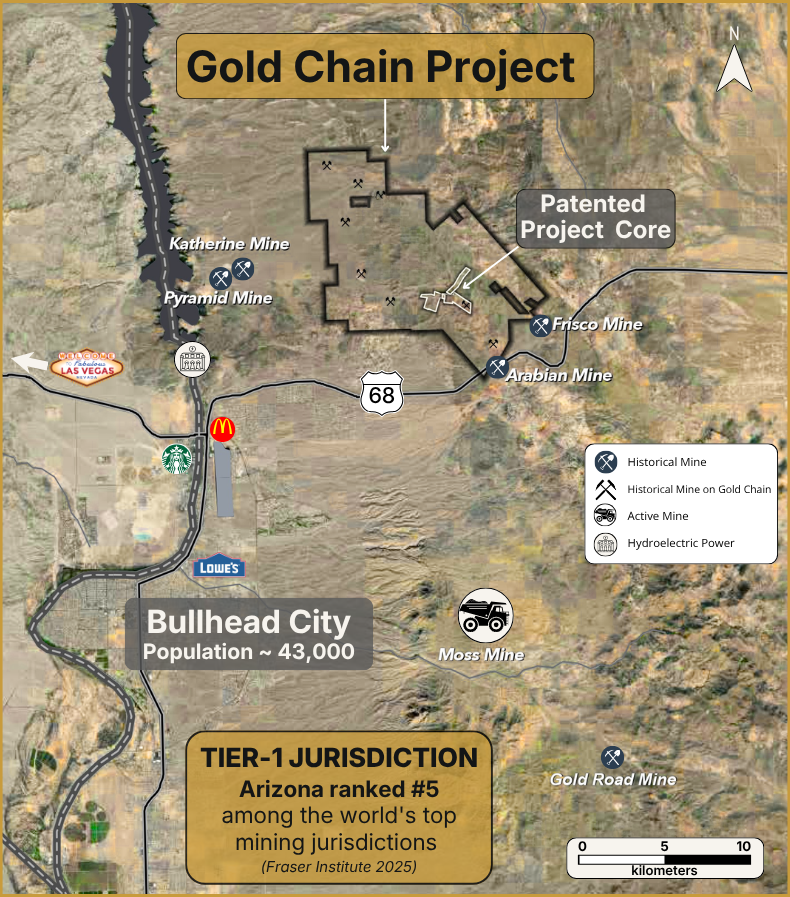
The Walker Lane is one of North America's most prolific gold trends, stretching from Nevada into Arizona and hosting some of the largest deposits on the continent. West Point Gold's flagship Gold Chain project sits on this trend in Mohave County, Arizona, about an hour and a half from Las Vegas, beside U.S. Route 68, with accessible power lines crossing the property and water rights tied to its patented claims. The ground has road access and a history of mining going back decades.
What makes it a discovery rather than a prospect is the drilling. The Tyro Main Zone (roughly one kilometre of a 3.4-kilometre vein system) is mineralized from surface and open in multiple directions and at depth. The high-grade NE Tyro zone now runs about 400 metres of strike and reaches roughly 350 metres below surface, still open. Repeated holes have returned high-grade intercepts, and a maiden mineral resource estimate for Tyro is anticipated.
Behind the rock is the part retail investors usually miss: ~C$25.1 million in cash and cash equivalents, a 21,000-metre program now fully reported with a 30,000-metre follow-up set to begin in October 2026, and a board that has built, financed, and sold mining companies before, including Prime Mining, which sold to Torex Gold for roughly C$450 million.
A 15-plus-kilometre mineralized structural corridor across ~11,500 acres, with one zone drilled out and advancing to resource, two more emerging behind it, and a district-scale fourth target now confirmed.
Drill defined over 1,000 m of strike with a >1 km surface expression; the 20,696 m drilled here feeds the maiden resource. Hosts the 13.48 g/t and 51 g/t intercepts - bonanza grades on a system open in three directions and at depth. The high-grade NE Tyro extension runs ~400 m of strike and roughly 350 m below surface and is still open, with up to 92% Au recovery confirmed through independent milling tests (KCA, April 2026).
Au = gold · g/t = grams per tonne · m = downhole metres · intervals are downhole length, not necessarily true width · source: WPG press releases Feb 28 2023 – Sept 9 2026
Broad, shallow, oxidized gold in quartz veining and breccia. 1,230 m drilled across two phases has outlined at least 200 m of strike and about 250 m down-dip, open in both. Best intercepts: 36.6 m @ 1.04 g/t Au from surface (GC26-095), 21.3 m @ 0.92 g/t (GC26-098), and from the August 2026 follow-up 7.6 m @ 2.22 g/t and 16.8 m @ 0.90 g/t. Drilling plus geophysics point to a deeper, potentially higher-grade feeder structure.
Near-surface veinlet- and breccia-hosted gold, most of it inside 60 m of surface: 32.0 m @ 1.05 g/t Au from 9.1 m (GC26-106), 19.8 m @ 1.42 g/t (GC26-111), 15.3 m @ 1.24 g/t (GC26-105) and 7.6 m @ 2.41 g/t (GC26-113). Consistent step-out grades support a third potential resource area at Gold Chain.
The June 2026 maiden drill test at Bull 8 hit gold in every hole, headlined by 21.4 m @ 1.01 g/t Au (GC26-136), with values increasing with depth. It confirms mineralization along a regional structure that runs roughly 12 km across the project and de-risks the adjacent Frisco Graben target - a 4 km x 750 m fault-bounded basin. Early-stage: a target, not a discovery.
Beyond Gold Chain, West Point Gold holds three advanced-stage Nevada projects, each capable of being a standalone focus for an explorer.
Located ~7 km from Kinross's Round Mountain mine, one of the largest open-pit gold mines in Nevada. Kinross is required to spend US$600K in exploration and can earn 70% with a US$5M payment to West Point, then a further 10% for another US$5M payment. It also pays West Point US$75,000 a year in lease payments. Kinross began drilling at Jefferson Canyon on September 23, 2026.
WPG keeps its interest funded by a major. 145 historic holes; highlight 41.2 m @ 6.4 g/t Au and 402 g/t Ag.
40 km from Round Mountain. 137 federal lode claims (~2,829 acres), 128 historic holes (~11,000 m). Multiple near-surface gold zones within 300 m of surface, with Carlin-style depth potential, Roberts Mountain Formation intersected at 400–700 m. Data compilation, geological modelling and permitting for a 5,000 m program are underway.
Near past-producers Borealis (~500 koz) and Aurora (~1.9 Moz Au). A ~3 km gold-in-soil anomaly; low-sulphidation epithermal system with ~6,900 oz historically produced from two veins. 156 historic holes (~7,300 m) already drilled.
In junior mining, you are betting on people as much as rocks. Each card below leads with the credential that matters most to a serious investor.
Full bios at westpointgold.com.
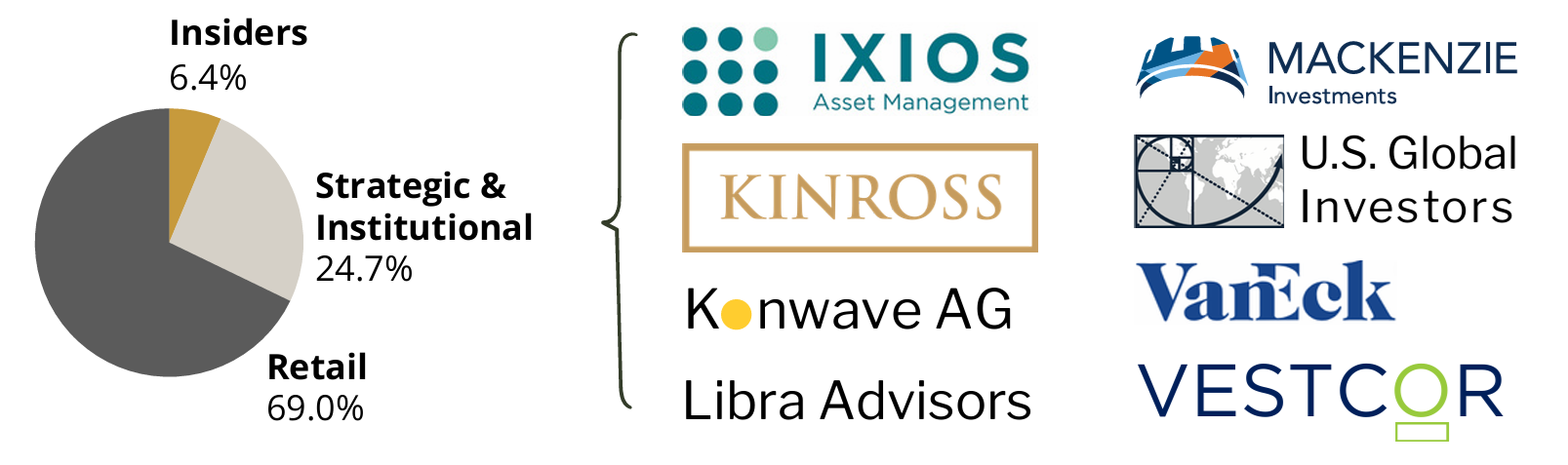
A clean share structure with growing institutional support - VanEck, Konwave AG, Mackenzie Investments, U.S. Global Investors, IXIOS Asset Management, VESTCOR, Libra Advisors and Kinross are on the register - and a treasury that funds the current drill program. Every outstanding warrant is in the money.
100% of warrants are in the money. Wtd.-avg. exercise price $0.53. Potential proceeds on full exercise ~C$7.8M.
Source: West Point Gold corporate presentation, October 6, 2026; cash and cash equivalents estimated as at June 30, 2026 (financial statements released Aug 26, 2026).
Grade is the most important number in gold exploration. West Point Gold already has it.
GC26-091 returned 13.48 g/t over 21.3 metres - a bonanza intercept. GC26-148 followed with 66.2 metres at 6.57 g/t, including 20.7 metres at 18.25 g/t from 219 metres downhole. A separate hole hit 184.4 metres at 1.00 g/t, starting right at surface. Holes across multiple zones - Tyro Main, NE Tyro, Black Dyke, Sheep Trail, and Bull 8 in the Union Pass corridor - have now come back above 1.0 g/t.
Consistent results across zones point to a real system - one with the geological repetition a maiden resource is built on.
West Point Gold had ~C$25.1 million in cash and cash equivalents at June 30, 2026. Another ~C$7.8 million in potential proceeds comes in if the 14.6 million warrants are exercised - and every one of them is in the money.
The current treasury reduces near-term financing risk and potential dilution during the active drill campaign. The treasury carries the company through the maiden resource milestone and into the new program.
The ~21,000-metre program is finished and fully reported. On September 9, 2026 the company announced the next phase of combined RC and core drilling. A 30,000-metre drill program is set to begin in October 2026.
It targets the high-grade NE Tyro and Tyro Main zones at depth and along strike, plus Black Dyke, Sheep Trail, Bull 8 and the Frisco Graben. Results come back on a 6- to 8-week cycle, which means steady news flow through the maiden resource and beyond.
A maiden resource turns drill results into a published ounce count. That's the moment analysts can model the project and serious investors can size a position.
The resource will be built on the 20,696 metres already drilled at Tyro, where the system is drill-defined over 1,000 metres of strike and the NE Tyro extension reaches roughly 350 metres below surface.
The exploration target is conceptual until drilling proves it. The 2026 program is built to answer that question.
Kinross operates the Round Mountain mine, just 7 kilometres from WPG's Jefferson Canyon property.
Kinross is actively spending its own money to advance the ground. It has committed US$600K for exploration, pays West Point US$75,000 a year in lease payments just to hold its position, and can earn up to 80% of the project for a total of US$10M in payments to WPG.
Kinross began drilling at Jefferson Canyon on September 23, 2026. Jefferson Canyon moves forward at zero cost to WPG shareholders.
On August 17, 2026, West Point Gold paid US$960,000 to extinguish a 2% royalty and a future resource bonus across 107 claims covering Black Dyke, Bull 8 and Gold Chain Hill.
Royalties are cheapest to buy before a resource is published. Doing it now means the two emerging satellite areas and the new district-scale target are 100%-owned and unencumbered going into the maiden resource.
Every junior explorer carries risk. Here are the hard questions about West Point Gold - and the honest answers.
Yes. A maiden mineral resource estimate for Tyro is anticipated, but it does not exist today. What de-risks the story relative to a greenfield play is that the high grades are already drilled, the system is mineralized from surface along 3.4 km, 20,696 metres are already in the ground at Tyro, and the next program is funded. The thesis depends on the drilling continuing to deliver. Size your position accordingly.
It means exactly what the cautionary statement says: 19.5–31.2 Mt @ 2.0–3.0 g/t is a conceptual range, not a mineral resource. There is insufficient drilling to define a resource, and there is no certainty it will become one. Treat it as a target the company is drilling toward, not booked ounces.
No. At NE Tyro the high-grade zone has held to roughly 350 metres below surface, which runs against the usual epithermal pattern of grades fading with depth - that is the bull case for something larger underneath, feeding toward the Frisco Graben. But at Tyro Main, some of the deeper holes came back weak or with no significant gold. The Frisco Graben is a target, not a discovery, and the deep thesis is the highest-risk part of this story.
Gold Chain is the driver, but the three Nevada projects, including the Kinross-funded Jefferson Canyon, provide optionality that most single-asset juniors lack. That said, the near-term re-rating thesis rests on Gold Chain's drill results.
A gold pullback hurts junior explorers more than producers, because junior valuations are leveraged to sentiment as much as fundamentals. The reverse is true on the upside. Commodity-price exposure is a real factor and is listed in the risks below.
West Point Gold is drilling a district-scale, high-grade gold system on U.S. soil, toward an anticipated maiden resource, with a funded 30,000-metre drill program set to begin in October 2026. Enter your email to get the full Report and follow the drill results as they land.
Certain statements in this publication constitute forward-looking statements or forward-looking information within the meaning of applicable securities laws, including National Instrument 51-102 of the Canadian Securities Administrators. Forward-looking statements include, without limitation, statements about: the announced 30,000-metre drill program and its timing and scope; an anticipated maiden mineral resource estimate for Tyro and the 20,696 metres of drilling to be used in it; the conceptual exploration target; future exploration results and news flow; the Kinross earn-in and drilling at Jefferson Canyon; the planned 5,000-metre program at Baxter Spring; and potential future market re-ratings.
The exploration target of 19.5–31.2 million tonnes grading 2.0–3.0 g/t Au is conceptual in nature. There is insufficient exploration to define a mineral resource, and it is uncertain whether further exploration will result in the target being delineated as a mineral resource. Drill intervals reported are downhole lengths and are not necessarily true widths. Forward-looking statements are based on assumptions management believes reasonable but are subject to known and unknown risks and uncertainties, including commodity-price fluctuations, exploration-result variability, and regulatory and capital risk, that may cause actual results to differ materially. Readers are cautioned not to place undue reliance on forward-looking statements, which are made as of the date of this publication. West Point Gold Corp. and Katusa Research undertake no obligation to update them except as required by law.